Assessments
What an Adult ADHD Assessment Usually Explores

In this article
- Before you begin
- The short answer
- What the diagnostic criteria look for
- What information may be included
- Questionnaires and structured interviews
- What about neuropsychological testing, TOVA, or other computer tests?
- What an assessment does not do
- Preparing for the conversation
- After the assessment
- References
A clear, evidence-informed overview of what an adult ADHD assessment may explore, why diagnosis takes more than a questionnaire, and how to prepare for the conversation.
Educational resource · not a diagnostic tool
This guide explains common parts of an adult ADHD assessment. It is not medical advice, does not diagnose ADHD, and does not replace care from a qualified clinician. Assessment practices and who may diagnose vary by location and clinical setting.
Before you begin
Adults may seek an assessment when ongoing problems with attention, organization, restlessness, impulse control, or daily follow-through affect work, education, home life, relationships, or well-being. ADHD is a neurodevelopmental disorder: symptoms begin in childhood, although some people are first recognized or diagnosed as adults. [1] [2] [4]
The short answer
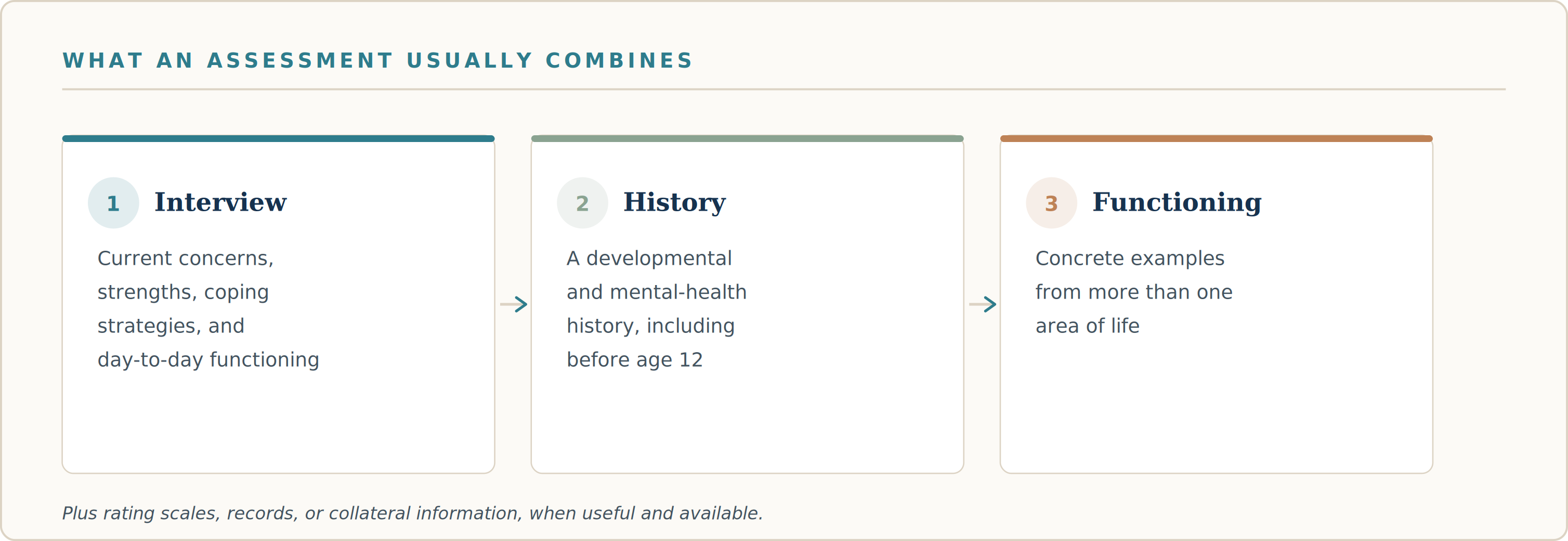
An adult ADHD assessment is a clinical process, not a single questionnaire, brain scan, or computer task. It usually combines an interview, a developmental and mental-health history, examples of functioning in more than one area of life, and—when useful and available—rating scales, records, or information from someone who knows the person well. The clinician also considers other conditions that could better explain the symptoms or may occur alongside ADHD. [3] [4] [5] [6]
What the diagnostic criteria look for
For adults age 17 and older, DSM-5 criteria use a threshold of at least five symptoms in the inattention group and/or at least five symptoms in the hyperactivity-impulsivity group. Symptoms must have lasted at least six months, several must have been present before age 12, and they must occur in at least two settings and interfere with functioning. A clinician must also consider whether another condition better explains the pattern. [1] [2] [3]
Symptoms may look different in adulthood. For example, visible hyperactivity may become inner restlessness. Diagnostic criteria focus on inattention and hyperactivity-impulsivity. Emotional regulation difficulties can still be discussed because they may affect daily life, but they are not a separate core DSM-5-TR symptom group for ADHD. [1] [4]
What information may be included
- A detailed conversation about current concerns, strengths, coping strategies, and day-to-day functioning. [3] [6] [7]
- A developmental history, including whether symptoms were present before age 12. School reports, prior evaluations, or family recollections may help when available, but an assessment can still discuss the evidence available and its limits. [1] [2] [4] [6]
- Concrete examples from at least two areas of life, such as work or education, home tasks, relationships, finances, driving, or social situations. [2] [3] [6]
- A review of mental and physical health, sleep, substance use, current medicines, and life circumstances. Anxiety, depression, trauma-related symptoms, bipolar disorder, sleep disorders, substance effects, learning disorders, and some medical conditions can overlap with ADHD or coexist with it. [3] [4] [6]
- With permission, information from a partner, relative, friend, or someone familiar with childhood may be requested. This can add context; the clinician should explain what is useful and what to do if such information is unavailable. [3] [4] [6]
Questionnaires and structured interviews
Rating scales can organize information, but a score alone cannot confirm or rule out ADHD. Results can also be affected by other conditions, so they must be interpreted alongside the full assessment. [3] [6]
- ASRS (Adult ADHD Self-Report Scale): A self-report screening tool. A positive screen means further clinical assessment is appropriate; it is not a diagnosis by itself. [6] [8]
- DIVA-5: A clinician-administered structured interview based on DSM-5 criteria that reviews symptoms and impairment in childhood and adulthood. [9]
- CAADID: An older semi-structured diagnostic interview based on DSM-IV. It has supporting validity evidence, but a clinician using it today should interpret it within current diagnostic criteria and a broader evaluation. [10]
Not every clinic uses the same tools. The name of a questionnaire is less important than whether the clinician gathers enough information to evaluate symptoms, onset, settings, impairment, and alternative explanations. [3] [6]
What about neuropsychological testing, TOVA, or other computer tests?
Neuropsychological or psychoeducational testing may be useful when there are questions about learning, memory, cognitive strengths and weaknesses, brain injury, or another diagnosis. It is not routinely required to diagnose ADHD, and normal test results do not by themselves rule ADHD out. [6] [11]
Continuous performance tests (CPTs)—including TOVA and similar attention tasks—measure performance during a structured task. A 2024 systematic review found limited and inconsistent diagnostic accuracy in adults. These tests should not be used alone to diagnose ADHD, although they may contribute to a broader assessment in selected cases. [12]
What an assessment does not do
- It does not diagnose ADHD from one questionnaire, one appointment observation, a brain scan, EEG, or a computerized attention score alone. [3] [5] [6] [11] [12]
- It does not assume that every attention problem is ADHD. Stress, sleep loss, mood or anxiety symptoms, substance effects, medications, medical conditions, and other factors may need consideration. [4] [5] [6]
- It does not guarantee a particular diagnosis or treatment. The outcome may be an ADHD diagnosis, another explanation, more than one condition, or a need for additional information. [3] [6]
Preparing for the conversation
You do not need to organize everything perfectly. If available, the following can help:
- A short timeline of attention, restlessness, organization, or impulse-control concerns, including what you remember from childhood.
- Examples of how the pattern affects work or school, home responsibilities, relationships, finances, driving, or health routines.
- Past school reports, previous psychological or medical assessments, and a current medication list.
- Questions you want answered and the name of someone who could provide background information, if you are comfortable involving them.
Ask ahead about appointment length, number of visits, cost, whether collateral information is requested, and when you can expect feedback. There is no single evidence-based timeline that applies to every adult ADHD assessment; timing varies with the setting, complexity, and information needed.
After the assessment
A useful feedback discussion should explain the evidence considered, any uncertainty or limits, whether diagnostic criteria were met, other findings, and reasonable next steps. Treatment is separate from diagnosis and should be individualized; options may include education, practical or psychological supports, workplace or educational accommodations, medication, or a combination. [3] [4] [6]
References
- American Psychiatric Association, ADHD fact sheet.
- National Institute of Mental Health, ADHD in Adults: 4 Things to Know.
- NICE Guideline NG87, ADHD diagnosis and management recommendations.
- Centers for Disease Control and Prevention, ADHD in Adults.
- Centers for Disease Control and Prevention, Diagnosing ADHD.
- CADDRA, Canadian ADHD Practice Guidelines, 4.1 edition.
- CADDRA, Diagnosis and Treatment for Adults.
- Kessler et al., WHO Adult ADHD Self-Report Scale.
- DIVA Foundation, Instructions for DIVA-5.
- Ramos-Quiroga et al., CAADID validity study.
- Planton et al., Neuropsychological assessment in adult ADHD.
- Varela et al., Continuous performance tests in adults.
- FDA, Safe use of prescription stimulants.
- DailyMed, Methylphenidate medication guide.
- MotherToBaby, Methylphenidate fact sheet.
- MotherToBaby, Dextroamphetamine-Amphetamine fact sheet.
Please note: This guide is for general education only. It is not medical advice, does not diagnose ADHD, and does not create a clinician–patient relationship.